
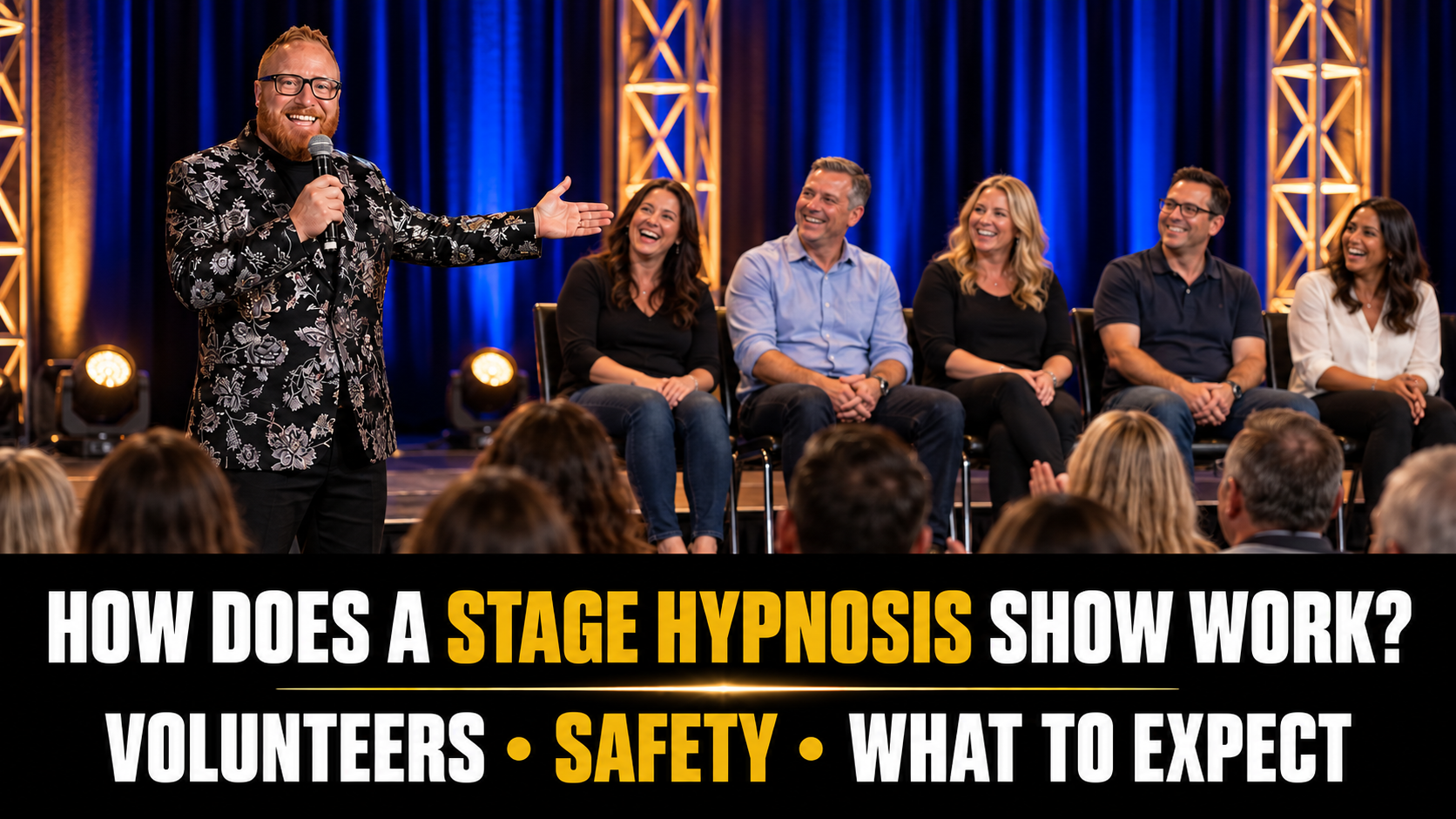
A stage hypnosis show combines imagination, audience participation and comedy to create a live experience that is different every time.
Volunteers are invited to the stage, guided through a series of relaxation and focus exercises, and encouraged to respond to entertaining suggestions. The rest of the audience gets to enjoy the volunteers’ reactions and the unexpected moments that develop throughout the show.
But what is really happening? Can anyone be hypnotized? Are participants in control? Here is what guests and event planners should know before attending or booking a comedy hypnosis show.
What is stage hypnosis?
Stage hypnosis is a form of live entertainment that uses focused attention, imagination and suggestion.
Unlike hypnotherapy, which is generally intended to help someone work toward a personal goal, stage hypnosis is performed for an audience. Its purpose is entertainment.
A professional stage hypnotist guides willing volunteers into a highly focused and responsive state. The hypnotist then introduces imaginative scenarios that allow participants to react creatively.
The volunteers are an important part of the performance, but the show should remain entertaining for everyone watching.
What happens at the beginning of a hypnosis show?
The hypnotist usually begins by introducing the show and explaining how participation works.
This introduction helps the audience understand that:
- Participation is voluntary
- Hypnosis is not sleep
- Volunteers can hear the hypnotist
- Participants are not surrendering control
- Imagination and concentration are important
- The experience works best when volunteers cooperate and enjoy it
The hypnotist may also perform short exercises with the entire audience. These exercises demonstrate how concentration, expectation and imagination can affect a person’s responses.
How are volunteers selected?
The hypnotist invites willing audience members to come to the stage.
People should never be forced or pressured to participate. Guests who prefer to watch can remain in the audience and enjoy the performance.
Once the volunteers are seated, the hypnotist guides them through exercises that help identify who is most focused and responsive. Not every volunteer will respond in the same way.
Some people concentrate quickly, while others need more time or are distracted by the audience, room or excitement of being onstage. The hypnotist may ask some volunteers to return to their seats so the show can continue with the most responsive participants.
Returning to the audience does not mean someone failed. It simply means the conditions were not right for that person at that moment.
What does being hypnotized feel like?
The experience can feel different for each person.
Some participants describe hypnosis as:
- Deep concentration
- Relaxation
- Becoming absorbed in an idea
- Responding without overthinking
- Losing track of time
- Feeling unusually imaginative
Most people remain aware of the room and can hear the hypnotist. They are focused on the experience rather than being unconscious.
A useful comparison is becoming deeply absorbed in a movie, book or activity. You still know where you are, but your attention is concentrated on what is happening.
Are people asleep during stage hypnosis?
No. Although hypnotists may use the word “sleep” as a cue, participants are not experiencing ordinary sleep.
The cue is generally used to help volunteers relax, close their eyes and return their attention to the hypnotist. Participants can still hear instructions and respond to suggestions.
The audience may see someone sitting quietly with closed eyes, but the participant remains engaged in the process.
Can a hypnotist control someone’s mind?
A stage hypnotist does not take control of a volunteer’s mind.
Participants respond because they are willing to engage with the experience. They retain their personal values and can reject a suggestion that makes them genuinely uncomfortable.
A professional performer does not rely on embarrassment, fear or pressure. The goal is to create situations that are funny for the volunteers as well as the audience.
Corrie J’s approach focuses on safe, clean fun that respects participants and suits the event.
What kinds of suggestions are used?
Suggestions vary according to the performer, event and audience.
Volunteers might be encouraged to imagine unusual situations, respond to imaginary objects, adopt playful characters or experience ordinary things in unexpected ways.
For example, participants might imagine:
- Being somewhere very hot or cold
- Meeting a famous person
- Taking part in a fictional competition
- Hearing a surprising sound
- Performing a harmless imaginary task
The exact material should be selected for the audience. A corporate banquet, school after-grad and private party may require different pacing and content.
Is stage hypnosis safe?
Stage hypnosis can be safe when it is performed responsibly by an experienced professional.
Safety includes more than the hypnosis itself. The performer must also consider:
- Safe access to the stage
- Stable chairs for volunteers
- Adequate room between participants
- Appropriate lighting
- Clear sound
- The age and needs of the audience
- The physical nature of each activity
- Respectful treatment of volunteers
- A proper conclusion to the experience
Event planners should provide accurate information about the venue and audience before the performance.
The hypnotist should also monitor volunteers throughout the show and avoid activities that are unsuitable for the participants or location.
Can anyone be hypnotized?
Many people can experience hypnosis, but responsiveness varies.
A volunteer is more likely to respond when they:
- Want to participate
- Feel comfortable with the performer
- Can concentrate on the instructions
- Are willing to use their imagination
- Are not distracted by the room
- Approach the experience with curiosity
Hypnosis is not a contest. Some people respond very visibly, while others experience it more quietly. Some may not respond enough for a stage performance even though they can still relax and follow the exercises.
Will volunteers remember the show?
Many participants remember the experience clearly.
A hypnotist may occasionally use a temporary suggestion involving memory as part of the entertainment, but this is not the same as permanently erasing someone’s memory.
After the show, volunteers often remember more as they speak with friends, see photographs or watch videos. Experiences vary from person to person.
What happens at the end of the show?
The hypnotist removes the show’s suggestions and guides the volunteers back to their usual level of alertness.
Participants should leave the stage feeling comfortable, positive and fully oriented. The performer may suggest that they feel refreshed and remember the experience as enjoyable.
A responsible conclusion is an essential part of a professional